

The short version
- There is no single best hearing aid. There is a best fit for your hearing, your ears and your life.
- Each manufacturer has its own fitting philosophy. When hearing aids are compared in their initial settings, you are often hearing those different starting points as much as the hearing aids themselves.
- Verifying each device with real-ear measurement first makes a comparison fairer, though it doesn’t make two hearing aids identical.
- Compare in the situations you actually struggle with, and decide what matters most to you before you listen.
Most hearing aid comparisons online focus on the devices themselves: features, chip names, battery life and app screenshots. Those things matter. But in my experience fitting hearing aids, the question people really want answered is simpler and harder: which of these will actually help me hear better in my life?
Answering that well means understanding how each manufacturer approaches sound, and how those approaches show up in a hearing aid’s starting settings. This guide explains what’s worth comparing, what can quietly distort a comparison, and how to set one up so the differences you notice are meaningful.
Why there isn’t one best hearing aid for everyone
Every major manufacturer makes capable, carefully engineered hearing aids. Where they differ is in their design philosophy: how aggressively they reduce background noise, how they decide where to focus, how quickly they respond to changing sound, how natural or crisp they sound, and how they connect to your phone and other devices.
Those differences are real, but whether a given difference helps you depends on several things that have nothing to do with the brand:
- Your hearing loss. Its degree, its shape across pitches and how well you understand speech all change what a hearing aid needs to do.
- Your ears. The size and shape of your ear canals affect which styles will be comfortable and stay in place.
- Your listening life. Someone who spends evenings in busy restaurants has different priorities from someone who mainly needs to hear the television and phone calls.
- Your preferences. Some people prefer a softer, more relaxed sound. Others want maximum crispness, even at the cost of some comfort.
That’s why “What’s the best hearing aid?” rarely has a useful answer, and “What’s the best hearing aid for me, and how would I know?” does.
What should you compare between hearing aid brands?
It helps to separate the things you can compare on paper from the things you can only judge by listening.
| What to compare | Why it matters | How to judge it |
|---|---|---|
| Speech clarity in noise | The most common reason people seek hearing aids, and where processing differs most between manufacturers. | Listening, ideally in a controlled, repeatable noisy scene. |
| Sound quality and comfort | A hearing aid you find tiring or harsh is one you won’t wear. | Listening over time; first impressions can mislead (see below). |
| Automatic noise management | How the hearing aid adapts as you move between quiet rooms, conversations and loud places. | Listening across several different scenes, not just one. |
| Physical fit and style | Comfort, security, how visible it is and whether it suits your ears and dexterity. | Trying it on. |
| Phone and Bluetooth connectivity | Compatibility with your phone, hands-free calling, TV streaming and apps. | Checking your specific phone and devices. |
| Battery | Rechargeable convenience versus replaceable batteries you can swap anywhere. | Your routine, travel habits and handling. |
| Controls and app | How easily you can adjust volume or programs when you need to. | Hands-on use. |
| Care and support | Hearing aids need ongoing adjustment, cleaning and occasional repair over their lifetime. | Asking what’s included, for how long and by whom. |
Specification sheets can narrow the field: if you need a particular style, a specific phone connection or a rechargeable battery, some options will drop out quickly. But the qualities people care about most, such as clarity in noise and how natural things sound, can only be judged by listening. And that’s where each manufacturer’s approach comes in.
How each manufacturer’s starting point differs
Every manufacturer builds its hearing aids around a philosophy of how sound should be delivered. Some place more emphasis on clarity and access to speech, others on a natural, comfortable sound or on preserving awareness of your surroundings. You can hear that philosophy in two places:
- How much amplification it provides, and at which pitches. This is the single biggest factor in how a hearing aid sounds. Each manufacturer uses its own proprietary formula to decide how much to amplify soft, average and loud sounds across the pitch range. A hearing aid giving you more high-pitched amplification will usually sound crisper; one giving you less will usually sound softer and more relaxed.
- How it handles changing environments. Manufacturers take different approaches to managing background noise, deciding where to focus and how quickly to react when a room gets louder. These automatic behaviours are a large part of what makes one brand feel different from another in a restaurant or group conversation.
When hearing aids are first connected to fitting software, the manufacturer’s formula calculates a starting point called a first fit. These starting points reflect each manufacturer’s philosophy and are designed partly for immediate comfort, so they don’t reliably match an independent, evidence-based prescription for your hearing loss, such as NAL-NL2, once the hearing aid is in your ear. Independent studies have repeatedly found that first-fit settings often fall short of prescriptive targets, particularly in the higher pitches that carry much of the clarity of speech.12
That has two consequences for comparisons. First, two manufacturers’ first fits may give you noticeably different amounts of amplification, so part of what you hear is the difference between their starting points. Second, a first fit that sounds pleasant in a quiet room may not be giving you the audibility you need. In one double-blinded study, most participants preferred hearing aids programmed to a verified prescriptive target over the manufacturer’s first fit, and they understood words in quiet significantly better with the verified fitting.3
The central idea: comparing hearing aids in their initial settings often tells you more about each manufacturer’s starting point than about how the hearing aids will perform for you. A fair comparison starts by fitting each device to the same evidence-based prescription, so the manufacturer differences that remain are the ones worth hearing.
What real-ear measurement tells us, and what it doesn’t
Real-ear measurement (REM), sometimes called probe-microphone verification, is how an audiologist checks what a hearing aid is actually doing in your ear. A very thin, soft tube connected to a microphone is placed in your ear canal beside the hearing aid. Sounds, including speech at soft, average and loud levels, are played, and the equipment measures what reaches the space near your eardrum.
Those measurements are compared with a prescription target calculated from your hearing test. The audiologist then adjusts the hearing aid until its output matches that target as closely as is appropriate for you. Professional guidance in audiology recommends this kind of verification as part of good hearing aid fitting.4 At Baitz Audiology, it is a standard part of every fitting.
For comparisons, this matters because verifying each hearing aid to the same prescription brings them to a much more similar, appropriate starting point. With that variable controlled, the differences you hear are more likely to come from the hearing aids themselves: their processing, noise management and overall sound character.
It’s just as important to be clear about what REM doesn’t do:
- It doesn’t make two hearing aids sound identical. Manufacturers still differ in how they process sound from moment to moment, handle noise and respond to changing environments, and those are exactly the differences worth comparing.
- It doesn’t prove which manufacturer is objectively best. It verifies important aspects of the fitting; your listening experience and priorities decide the rest.
- It doesn’t replace follow-up. Verification gives you an appropriate starting point, and fine-tuning based on your real-world experience comes after.
How to compare hearing aids in realistic listening situations
Once each hearing aid is fitted to the same prescription, the next challenge is the listening itself. A few principles make a comparison much more reliable:
- Use the same situations for each hearing aid. Comparing one hearing aid in a quiet office and another in a busy café tells you about the rooms, not the devices. Repeatable, controlled scenes let you switch between hearing aids and listen to exactly the same thing.
- Include the situations you actually find difficult. If restaurants are your challenge, a quiet room won’t reveal much. Speech from different directions, background chatter, music and sudden loud sounds all test different aspects of a hearing aid.
- Listen for what matters to you, not just what’s louder. Louder often sounds “better” in a brief comparison. Ask yourself which is easier to follow, more comfortable to listen to and less tiring.
- Reduce bias where you can. Knowing a brand name, price or a friend’s recommendation can shape what you hear. Where possible, listen before discussing which device is which.
- Treat first impressions with some caution. If you are new to hearing aids, sounds you haven’t heard clearly in years, like your own footsteps or the rustle of paper, can seem sharp at first. Over the following weeks your brain adjusts, and what feels slightly too crisp on day one often becomes natural.
A comparison appointment can’t fully replace wearing hearing aids in your own life. What it can do is help you choose a direction with confidence, so that your real-world trial starts with the option most likely to suit you.
Which hearing aid differences matter most to you?
Before comparing, it helps to rank what you care about. A few questions worth thinking through:
- Where do you most want to hear better: conversations at home, group settings, work meetings, restaurants, the car, the television?
- How important is a natural, comfortable sound compared with maximum clarity?
- Do you want hearing aids that are as discreet as possible, or are easy handling and simple controls more important?
- Do you prefer recharging every night, or swapping batteries every week or so?
- How do you use your phone, and do you want calls and audio streamed directly to your hearing aids?
- Are there specific situations, like music, travel, sport or noisy work, that place special demands on your hearing aids?
Bring your answers to your appointment. They help narrow which manufacturers are worth comparing and focus the listening on what will actually make a difference to you. If you’d like a head start, our hearing aid brand quiz uses your priorities to suggest which manufacturers may be worth exploring.
Experience the differences in the Listening Lab
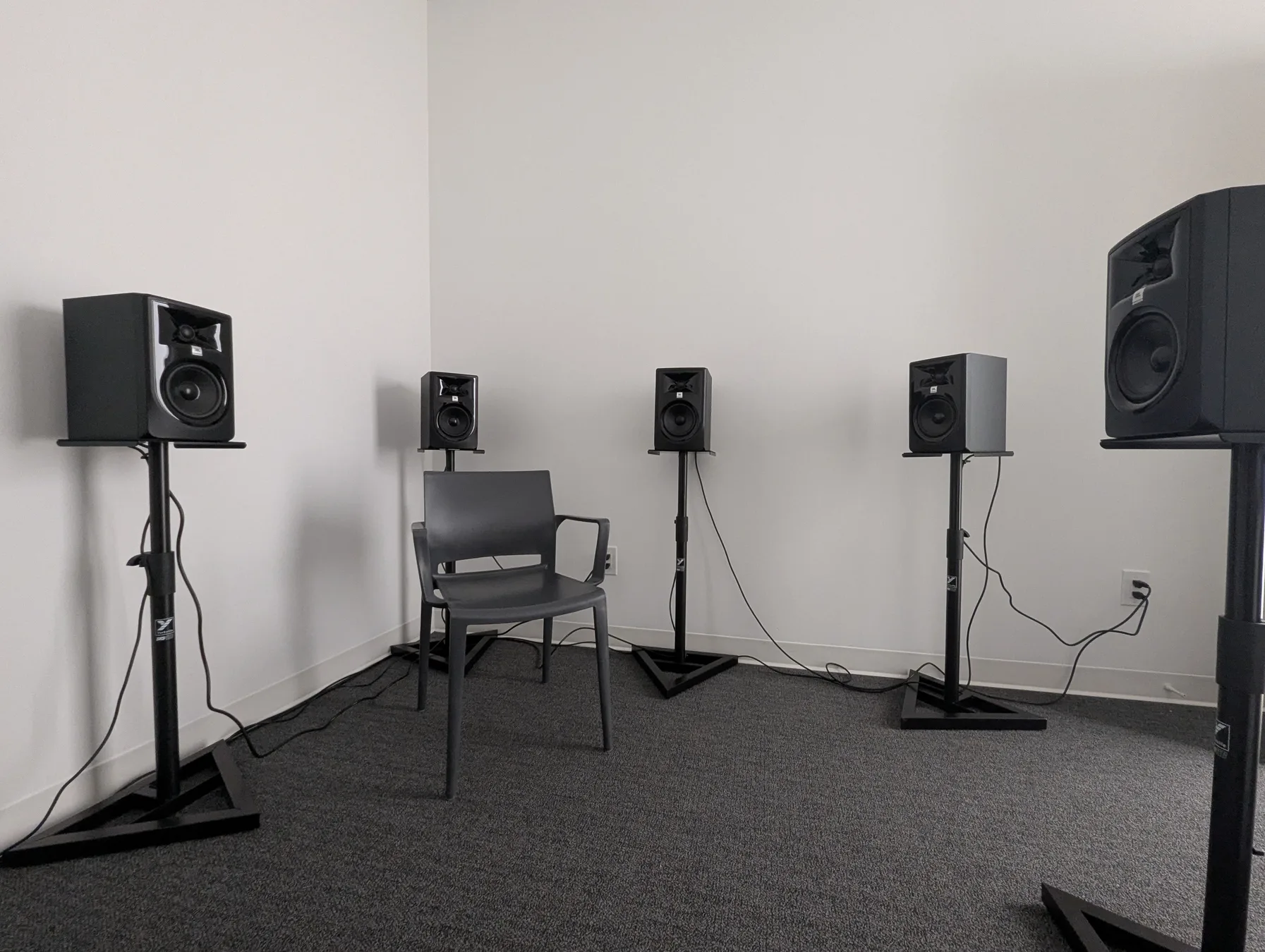
The Listening Lab at Baitz Audiology was built around the principles in this guide. After a comprehensive hearing assessment, we help you choose two or three manufacturers worth comparing. Each hearing aid is verified with real-ear measurement, and you then compare them in recreated everyday situations using our 8-speaker system, the same scenes for every device.
You leave with a clearer sense of which direction suits you, a copy of your hearing test and a signed prescription for your selected devices. Learn how the Listening Lab works, or read more about our approach to hearing aids.
Common questions
Which hearing aid brand is the best?
There isn’t one brand that is best for everyone. The major manufacturers all make capable, well-engineered hearing aids, and they differ in how they process sound, manage noise, connect to phones and feel to wear. The best choice depends on your hearing, your ears, the situations that matter most to you and how well the hearing aids are fitted.
Can I compare hearing aids by trying them in the store?
A short in-clinic demonstration can tell you about comfort, size and general sound, but it has limits. If the hearing aids are running on their initial software settings, part of what you hear is each manufacturer’s starting point. A more meaningful comparison uses devices that have each been verified for your ears and compared in the same listening situations.
What is real-ear measurement?
Real-ear measurement (REM) uses a very thin probe microphone placed in your ear canal, beside the hearing aid, to measure the sound the hearing aid is actually delivering near your eardrum. Your audiologist compares that measurement with an evidence-based prescription for your hearing loss and adjusts the hearing aid to match it.
How long should I try hearing aids before deciding?
Your brain needs time to adjust to amplified sound, especially if you are a first-time user. A comparison appointment helps you choose a direction, but real-world use over several weeks is what confirms it. At Baitz Audiology, new hearing aid purchases may be exchanged or returned within 90 days.
References
- Sanders J, Stoody T, Weber J, Mueller HG. Manufacturers’ NAL-NL2 fittings fail real-ear verification. Hearing Review. 2015;22(3):24.
- Aazh H, Moore BCJ, Prasher D. The accuracy of matching target insertion gains with open-fit hearing aids. American Journal of Audiology. 2012;21(2):175–180.
- Valente M, Oeding K, Brockmeyer A, Smith S, Kallogjeri D. Differences in word and phoneme recognition in quiet, sentence recognition in noise, and subjective outcomes between manufacturer first-fit and hearing aids programmed to NAL-NL2 using real-ear measures. Journal of the American Academy of Audiology. 2018;29(8):706–721.
- American Speech-Language-Hearing Association. Guidance on the verification of hearing devices using probe microphone measurements.
This guide is general education, not individual medical advice. The right hearing aid depends on your hearing assessment, your ears and your listening needs.